
By Karen Ronney
A Personal Tribute to A Great Coach
Gordon ZawTun had a quietly powerful presence. He was small in stature, but big in impact. He received the RSPA San Diego Bob Bacon Lifetime Achievement Award in 2025 and passed away on April 20, 2026. He was 71 years-old.
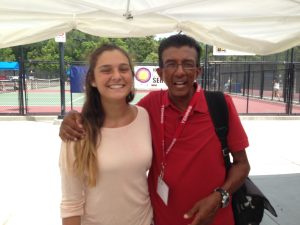
I first met Gordon at the 2015 USTA Boys and Girls 16s Zone Championships in Salt Lake City. He was one of five USTA Southern California coaches that were assigned to teams representing that area. It was a blessing to watch this iconic coach in action as he led a group of high-performance teens through a week-long intense tennis competition.
The Zonal teams came from areas within the Western U.S. and Hawaii. Each squad consisted of twelve top-ranked talented juniors: six boys and six girls. Every match consisted of singles, same gender and mixed doubles. Gordon led the So Cal Renegades, and my daughter, Julia, was blessed to be a part of his team. I was fortunate to be part of the parent crew.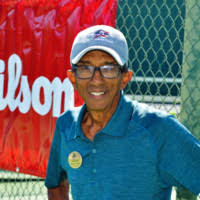
Gordon was an expert at providing unique perspectives, encouraging independent thinking and creating team chemistry. He accepted the almost impossible task of coaching a group of talented teenaged athletes with strong minds, developing egos and diverse personalities. His coaching quest was to guide them through tough matches – within 24 hours of meeting them. Add in the challenge of managing tennis parents. It was a tough gig, but Gordon succeeded. By the end of the event, he earned the respect of both players and parents along with their admiration, loyalty and gratitude.
At the orientation, Gordon met with the players and their parents to share his coaching philosophy and expectations. It was simple. He asked each athlete to bring their best to the tennis court every day. Show respect for all, compete with honor and take responsibility for their tennis. To Gordon, that meant players should prepare their own equipment and take care of their tennis needs. He asked them to be punctual, supportive and show kindness to all. The parent’s role should be minimal and focus on the fundamentals such as providing food, transportation and encouragement. No coaching or criticism allowed. Then, he asked the players to make team posters to be displayed at each match. He provided poster boards and art supplies for the task.
The next day, Gordon quietly observed the players as they practiced with one another. He did not demand specific drills. He merely suggested they hit while he observed their groundstrokes, net skills and he noted how they moved and behaved on the court. This was how he determined doubles pairings and match line-ups.
Gordon believed having a team cheer was essential to building a great culture. He gave the group the task of creating a Renegade cheer. As young teens can be, they were hesitant and embarrassed to speak out. He gave the players general ideas and asked them to create something. Gordon had a way of encouraging the kids and made them feel safe to try. The group embraced the challenge. When the Renegades opened their first match, their team cheer could be heard across the facility. They bonded over that cheer, and it got louder each day.
Another way Gordon celebrated success was by honoring one boy and one girl for their performance after each match. He had a formula that calculated games won vs games lost. The players with the highest number of games won – regardless of their position on team – received gift certificates for ice cream at Baskin-Robbins.
Off-court time was also important to Gordon for team building and camaraderie. The Zonal tournament was held over July 4th weekend and Gordon arranged for the players see highlights of Salt Lake City. They went to various eateries, shopping centers, and to a fireworks show.
“Being on Coach Gordon’s Zonal team was one of my favorite junior tennis memories,” said Julia Ronney, who played NCAA Division I tennis at the University of Montana. “He made me feel like an important part of the team. We had fun whether we were playing tennis, hanging around the hotel or exploring the city. He let us have a say in how we wanted things to go, and sometimes he let us pick our doubles partners.”
Motivation was one of Gordon’s strong coaching qualities. Before each match, he shared true-life experiences of what it means to be a champion. He had a notebook that housed a collection of motivational stories. These are some of the stories he shared with the Renegades and their parents.
- Walt Disney was fired by a newspaper editor because he lacked imagination and did not have any good ideas. Disney was also told the theme park would only attract riffraff and the City of Anaheim denied his plans on multiple occasions. He went bankrupt several times before building Disneyland became the theme park it is today.
- Thomas Edison’s teachers told him he was too stupid to learn anything. He was fired from his first two jobs for being non-productive. He had more than one-thousand attempts while trying to invent the light bulb. When asked about how it felt to fail one-thousand times, he said he never failed. It was just that inventing the light bulb took one-thousand steps.
“You will learn more from your losses than you will ever learn from your wins,” Gordon said. “So when you eventually win, it took that many steps to become a champion. Keep that in mind. I wish it were that easy that everyone could start winning right off the bat, but it takes many steps to become a winner.”

Other Gordon ZawTun stories:
- Inventor Albert Einstein did not speak until he was 4 years old and he did not read until he was age 7. His parents thought he was “sub-normal.” One of his teachers described him as “mentally slow, unsociable and adrift. Forever in foolish dreams.” He was expelled from school.
- Cartoonist Charles Schultz, who created the comic “Peanuts”, submitted early drafts to his high school yearbook. It was rejected.
- Fred Astaire, one of the greatest actors and dancers of the 1930s, was rejected after his first screen test. It is reported that producers wrote in a memo, “He can’t act, he can’t sing, he is slightly bald and can dance a little.” Astaire hung that memo over his fireplace in his Beverly Hills home.
- Decca Records declined to sign the Beatles in 1962 saying “We don’t like their sound. Guitar groups are on their way out.” Several other major labels passed on the band before they found their home at EMI’s Parlophone Label.
- In 1960, Liberty Records kicked a young singer named Reg Dwight out of its office and complained that Dwight’s talent was a “waste of their time.” That same singer is known today as Elton John.
Said Gordon: “Imagine if these people had given up because they thought they were doomed to fail? They would’ve never achieved success. Do you think they ever felt down or depressed? Sure they did, but they never allowed those feelings to take over. They followed their desires to succeed, and in every case, exceeded their wildest dreams. That experience can be viewed as positive in hindsight. Their failures were actually steppingstones, not stumbling blocks. It is your choice, so be determined and never give up.”
For more than four decades, Gordon’s coaching journey included serving as the Director of Tennis at the Palm Valley Country Club, and he was a professional at The Ritz-Carlton in Rancho Mirage. He ran the prestigious USTA Henry Talbert Junior Championships and many other USTA tournaments. He led Junior Team Tennis programs and was a USTA high-performance coach.
Gordon was born in Rangoon, Burma (now Myanmar), and became a leader in the So Cal desert tennis communities. He was deeply respected within the industry, recently honored with the Coach Dave Borelli Leadership Award at the 14th Annual Orange County Community Tennis Seminar. Following his passing, the local tennis community and the Love and Love Tennis Foundation established the Gordon ZawTun Memorial Scholarship to continue his legacy of developing junior talent in the desert.
The Renegades did not win the 16s Zonals that year. In fact, I believe they finished fourth overall. But it didn’t matter. Having Gordon ZawTun as their coach was the biggest prize possible.
I feel so blessed to be able to call Gordon my friend. He made a lasting impact on my coaching career. He set the bar on how to be a kind, loving and accepting leader. He met his students where they were and guided them to be better people on and off the court. This was Gordon’s motivational story when meeting with the Renegades for the last time:
“The Sequoia tree is believed to be one of the largest and oldest living things in North American Continent. One in particular is called the General Sherman Tree. These are a few facts concerning this magnificent tree. It has been measured as 272 feet, 4 inches tall. The base circumference of the tree is 101 feet, 7 inches. It would require 17 men arm-in-arm to encircle the base of the tree. It is estimated to contain over 6,000 feet of lumber, sufficient enough to build 35 five-bedroom homes. In places the bark is up to 24 inches thick. This tree is estimated to weigh up to 1,350 tons. Now consider this…the seed of a sequoia weighs .005 grams (like the flake of oatmeal.) This represents a growth from seed to maturity to 100,000%.
“The same creator who created that seed, created each and every one of you. Do you believe he would give any one of you less potential for growth? You all have a phenomenal amount of potential for growth. Use it.”
Then, he shook the hand of each of his players and said: “Have a safe trip and I hope to see you again soon.”
Gordon, you were indeed a Giant Sequoia kind of coach. You helped plant thousands of seeds of greatness in your lifetime. Thank you. Your legacy lives on.
###
About the Southern California Tennis Association Foundation:
We are a 501c3 nonprofit organization and is the charitable arm of USTA Southern California. The Foundation’s mission is to “Change lives and build communities through tennis.” Since 2020, the SCTA Foundation has had a community impact of giving over $1million in tennis grants and tennis scholarships to deserving youth, adults, tennis organizations, tennis facilities and tennis programs to make tennis an equal opportunity sport, accessible to all, regardless of age, ability, ethnicity, or economic background. Visit us on Social Media on Instagram and Facebook. To learn more about the SCTA Foundation go to: www.sctafoundation.org. To donate go to: sctafoundation.org/donate/.