
By Karen Ronney
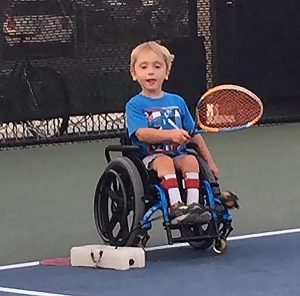
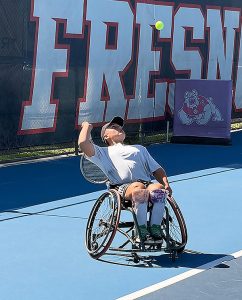
For 13-year-old Micah Velte, the tennis court isn’t just a place to play, it’s where he’s building a future. Born with Spina Bifida, Micah has spent a decade navigating the world from a wheelchair, but on the court, he isn’t just a participant. He has become a rising force. Currently ranked No. 5 in the Junior A Division and No. 3 in Adult B, Micah is proving that with the his team of coaches and an unwavering spirit, his potential is unlimited.
Recent Success
For the first time, Micah won the COED Adult B Singles and Doubles Titles at the Arizona Level 3 Open Wheelchair Tournament. While it is clear that Micah has the talent and drive to reach his goals, the cost of travel often remains a barrier. The SCTA Foundation is happy to help Launch His Dreams through scholarships.
“Micah is an amazing young man who deserves every opportunity to reach his goals and we are happy to support his journey,” said Linda Milan, the Executive Director of the Southern California Tennis Association Foundation. “He has the passion and determination along with a dedicated support system from his family and coaches. His future is bright.”
Photo credit: USTA SoCalA Legacy Born at Three
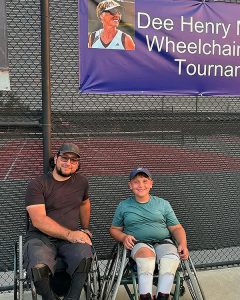
Micah’s tennis journey began at age three under the wing of the late iconic Coach Dee Henry, a legendary pioneer in wheelchair tennis and long-time coach at Biola University.
“Coach Dee made Micah love tennis,” says his father, Jonathan Velte. “Her style was so welcoming and supportive. Micah’s passion for tennis and his success is all due to her influence.”

That foundation is now being built upon by a “village” of mentors. Coach Keith Orahood of T3 Adaptive Racquet Sports focuses on Micah’s stroke production and training.
“Coach Keith has helped me continue what Coach Dee started,” Micah said. “He is the coach that encourages you. If you mess up he doesn’t care. Just try again. He believes in me.”
Coach Henry Reyes, who was also mentored by Coach Dee, works on his Micah’s mental game and strategy. Together, they are refining a player who Coach Keith describes as having “incredible fundamentals” and a rare ability to shift seamlessly from defense to offense.
“Micah is powerful and has good control over his shots,” Coach Henry said. “Recently we have been working to stay positive. I’ve tried to instill in him that you may be down, you still have a chance.”
The Mental Edge
For Micah, changing his grip that produced a “pancake serve” to a professional-style serve with spin and kick has been a game-changer. But the biggest hurdles aren’t physical.
“The mental game is a huge part because it’s easy to get down on yourself,” Micah said. Under Coach Henry’s guidance, Micah has learned to use the precious minutes during side changes as a reset button. He has learned to take a breath, eat a bite of food, and focus on how to win the next game.
“Tennis is not about the win vs. the loss, it’s about how you handle it,” said Coach Henry. “It’s about learning to recover and not let the loss put you in a hole.”
A Family Transformed
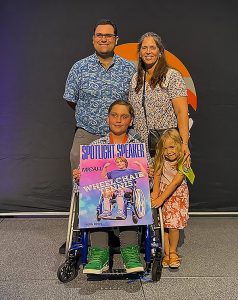
While Micah’s 3-year-old sister, Abigail, cheers from the sidelines, Jonathan and his wife, Megan, have embraced the unique path their family has taken.
“Micah’s disability altered our lives, but in a positive way,” Jonathan said. “We have learned and grown together.” That growth is visible on the court, where Jonathan often hits with Micah. “I used to be able to beat him,” Jonathan said. “Now I’m lucky to get two or three games.”
Breaking Barriers: From Middle School to High School and Beyond
Micah currently trains a minimum of 10 hours a week in an Independent Study Physical Education program outside of school to hone his tennis skills because his middle school’s dirt fields are not wheelchair-friendly. He also plays tournaments on the weekends. This dedication is fueled by massive goals:
- High School: Competing on his school’s ambulatory team (where the only difference is he gets two bounces to a stand-up player’s one).
- College: Playing wheelchair tennis at the university level, a goal he is already researching at age 13 to understand his options.
- The Dream: Representing the U.S. in the Paralympics.
While Micah loves tennis, he also has a passion for music. He joined the middle school band and plays the euphonium, akin to a small tuba. He plans to pursue music and band in high school in addition to tennis. “Micah is discovering he has many different talents,” said his father, Jonathan. “But I think his success in tennis has given him the confidence to try new things. Little did he know music would be another kind of passion.”
A Community Effort
Micah’s tennis success has truly been a community effort. One of biggest challenges was getting a tennis-specific wheelchair. Thanks to a grant from the Challenged Athletes Foundation and a connection through San Diego State University Wheelchair Coach Greg Hasterok, Micah had a heavy basketball wheelchair and will soon be receiving a lightweight model made by Vesco.
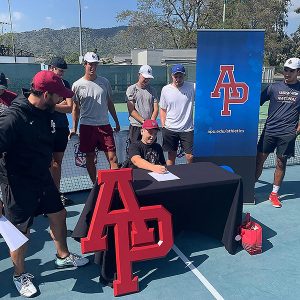
He’s also gaining “big league” experience through Team IMPACT, which has “signed” him to the Azusa Pacific University men’s tennis team. Attending their matches gives Micah a taste of the high-energy atmosphere of college sports. “College tennis is like going to a party,” Jonathan says. “This way, he can begin to connect the dots on where he wants to go in life.”
For Micah, every practice and every tournament is a step toward a larger purpose. As he puts it: “I’ve learned to identify what I need to do to reach my goals. I am thankful for my family and coaches, and all of the people who have helped me along the way.”
About the Southern California Tennis Association Foundation:
We are a 501c3 nonprofit organization and is the charitable arm of USTA Southern California. The Foundation’s mission is to “Change lives and build communities through tennis.” Since 2020, the SCTA Foundation has had a community impact of giving over $1million in tennis grants and tennis scholarships to deserving youth, adults, tennis organizations, tennis facilities and tennis programs to make tennis an equal opportunity sport, accessible to all, regardless of age, ability, ethnicity, or economic background. Visit us on Social Media on Instagram and Facebook. To learn more about the SCTA Foundation go to: www.sctafoundation.org. To donate go to: sctafoundation.org/donate/.